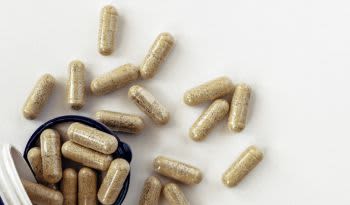
You’re not alone if you’ve ever stood in the supplement aisle staring at a label thinking, 'What does any of this actually mean?' As an ER nurse, I see patients every day who take supplements without fully understanding what they’re putting into their bodies. Many supplements are helpful, some are harmless, but others can interact with medications, cause side effects or simply not do what you think they do.
Learning how to read supplement labels is essential for making safe, informed choices. Let’s break it down step by step so you can confidently understand what’s actually in your supplements.
Key takeaways
- Read the label: supplement labels provide essential details about ingredients, dosage and daily values, helping you make informed and safe choices.
- Understand serving size: always check serving size and servings per container to understand how much you’re actually taking each day.
- More isn’t always better: 'amount per serving' and % Daily Value (%DV) show how a supplement fits into your daily nutrient needs – and more isn’t always better.
- Ingredients matter: the ingredients list reveals both active and inactive components, and proprietary blends are a red flag due to a lack of transparency.
- Choose high-quality supplements: look for supplements with third-party testing, avoid unnecessary additives and consult a healthcare professional before mixing with medications.
What is a supplement label?
A supplement label is your roadmap to what’s inside a product. It tells you:
- Nutrients and/or ingredients included
- Number of tablets, capsules, gummies or scoops in a serving
- How much of each nutrient or ingredient is in a serving
- Percent of daily values (%DV) for included nutrients
- How often to take it
Think of it like the nutrition facts panel on a food label. And while supplement labels are mandatory and standardised by the Food and Drug Administration (FDA), supplements aren’t regulated as strictly as medications. Supplement manufacturers are responsible for evaluating the safety, accuracy and labelling of their own products.1 So, it’s important to purchase supplements from reputable brands and read the label thoroughly so you know what you’re getting.
Serving size and servings per container
How many times have you glanced at a supplement bottle, noting that it provides the desired amount of your target nutrient – but when you look closer, you realise you actually need to take three capsules to get that amount?
Serving size and servings per container are some of the most commonly misunderstood parts of a supplement label. Here’s what they tell you:
- Serving size: how much of a supplement you need to take to get the nutrient amounts listed on the label
- Servings per container: how many doses are in the bottle
So, if you take only one capsule, tablet, softgel or gummy, but the serving size is two, you’re only getting half of the nutrients and other ingredients listed on the label. Likewise, a supplement bottle may contain 90 capsules, but that’s only a 30-day supply if the serving size is three capsules.
Amount per serving and % daily value (%DV)
This section tells you how much of each nutrient you’re getting in one serving and how it fits into your daily nutritional needs. Nutrients are listed with units such as:
- Milligrams (mg): commonly used for vitamins like vitamin C or minerals like calcium
- Micrograms (mcg): used for trace elements and vitamins your body only needs very small amounts of, like B12 and iodine
- International units (IU): used for fat-soluble vitamins like vitamins A, D, E and K
The %DV tells you how much of your daily recommended intake for each nutrient is in one serving.
- 5% DV or less is considered low
- 20% DV or more is considered high
Some ingredients, like herbal extracts, don’t have an official %DV. For these ingredients, you’ll see only the amount per serving listed.
If you think more of a nutrient is always better, think again. High %DVs may be helpful for water-soluble nutrients that you’re not getting enough of, like B vitamins. But high doses of fat-soluble vitamins, like vitamin A or D, build up in your system and can be harmful. To avoid this, have your blood levels checked before supplementing and talk with your doctor or registered dietitian before taking high doses of any nutrient to be sure it’s safe for you.
Unpacking the ingredients list: what’s really inside?
The ingredients list includes everything in the supplement – not just the active nutrients. Learning how to read this section helps you avoid unwanted additives and better understand product quality.
Active vs. inactive ingredients
Active ingredients provide the supplement’s intended health benefits. These nutrients are the ones you’re actually taking the supplement for, like vitamin C or magnesium.
Inactive ingredients are those that support the supplement’s structure, stability or taste. They include fillers, binders, dyes and preservatives. While we often recommend choosing supplements that are free of unnecessary ingredients, it’s important to remember that inactive doesn’t mean unimportant. Some inactive ingredients are included to improve the absorption of the active ingredients.
Proprietary blends and complexes
When you see 'proprietary blend' listed on an ingredients list, it means you don’t know how much of each ingredient is in the supplement. Nutrients and other ingredients are grouped together without disclosing exact amounts, making it difficult to know what you’re actually taking. This is a big red flag.
As an ER nurse, I always remind my patients that transparency matters. If you can’t see the exact amounts of what you’re taking, don’t take the supplement.
Common 'other ingredients' and their purpose
Most supplements contain inactive ingredients that serve important purposes beyond imparting health effects. They may include:
- Binders: ingredients like magnesium stearate, which hold tablets together
- Capsule: gelatine and/or cellulose are often used to form the capsule
- Fillers: add volume
- Flavourings or sweeteners: improve the taste of powders or chewables
- Colouring agents: enhance appearance
While I always recommend choosing supplements that are free of unnecessary ingredients, not all additives are harmful. And some are essential for the effective delivery of active ingredients.
Allergens and warnings
If you have allergies, always check the label for allergen statements. Many supplements list when a product contains gluten, soya, dairy or shellfish. Likewise, check for warnings related to pregnancy, medications or specific health conditions.
Understanding units of measurement
Supplement labels use different units depending on the nutrient’s potency and how much of it your body needs. While milligrams (mg) are used for larger quantities of a nutrient, micrograms (mcg) are often used for trace amounts. These units indicate how much of a nutrient a supplement contains.
International Units (IU) reflect the biological activity of a nutrient rather than weight alone. For example, vitamin D may be measured in IU because its effectiveness depends on how much your body can absorb and use, not just how much is in the supplement.
Colony-forming units (CFU) are another unit of measurement you may see on probiotic supplements. This indicates the number of living bacteria in a probiotic that can multiply and form a colony.
Tips for choosing quality supplements
When you shop for supplements, keep in mind these key tips for choosing high-quality supplements:
- Look for third-party testing or seals (like NSF or USP)
- Choose brands with clear, transparent labels
- Avoid excessive fillers or dyes
- Steer clear of proprietary blends
- Always check expiration dates
- Talk with your healthcare provider before taking supplements along with medications
Conclusion
As an ER nurse, I don’t want you to be afraid of supplements – I want you to be informed. Supplements can support your health, but they can also cause harm if you don’t understand what or how much of a nutrient you’re taking.
Reading a supplement label isn’t complicated once you know what to look for. By understanding serving sizes, ingredient lists and nutrient values, you can make smarter, safer choices that align with your health goals. Take control of your health by understanding what you’re taking!
References:
- Dietary Supplements | FDA. Accessed April 13, 2026. https://www.fda.gov/food/dietary-supplements
DISCLAIMER:
These statements have not been approved by the Food and Drug Administration. These products are not intended to diagnose, treat, cure or prevent disease.


























































 Table of Contents